

Personal Finance for Beginners: A Complete 2026 Guide

What is Personal Finance for beginners?
Personal finance for beginners is the active process of managing your income, spending, and investments to achieve long term security. In 2026, this means navigating a high inflation economy where a ₹20 chai now costs ₹50. It is about building a system where your wealth grows faster than your lifestyle expenses.
Many people enter adulthood without these skills. They earn money, spend it, and hope for the best. Without a plan, this leads to debt and constant stress. Financial stability is not about how much you earn, but how much you keep and grow.
Why financial planning is non-negotiable in 2026
Financial success is rarely an accident. Even high earners in tech hubs like Gurugram or Bengaluru struggle because they lack money management habits. Proper planning helps you control spending, reduce stress, and prepare for emergencies.
The pain points are real. Rising rents and the pressure of “lifestyle creep” make it hard to breathe. If you feel like your money vanishes before the 15th of the month, you are not alone. You just need a better framework.
While starting early is great, many people fail because of simple errors. Read also: financial mistakes Indians must avoid to build wealth to ensure your plan stays on track.
Step 1: Master your cash flow with the 50/30/20 Rule
The first step is understanding your cash flow. This means tracking every rupee that enters and exits your bank account. You cannot manage what you do not measure. A simple framework to follow is the 50/30/20 rule.
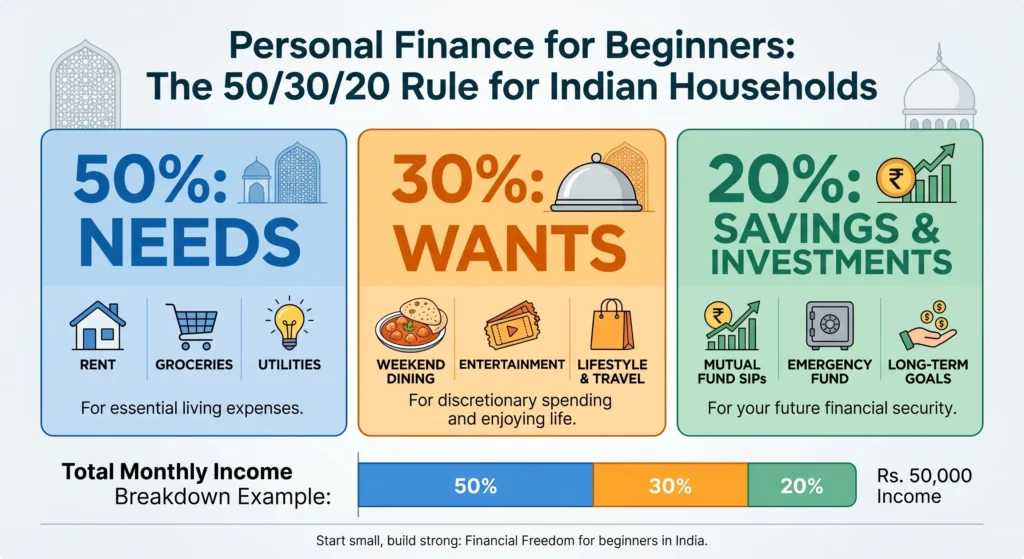
- 50% for Needs: This covers your non-negotiables. Rent, groceries, utility bills, and minimum debt payments.
- 30% for Wants: This is your “fun” bucket. Dining out, OTT subscriptions, and travel.
- 20% for Financial Goals: This is the most critical slice. It goes toward your emergency fund and investments.
Pro-Tip: In 2026, apps like Axio (formerly Walnut) or ET Money can automate this tracking by reading your transaction SMS. Let technology do the heavy lifting.
Step 2: Build an emergency fund (The Survival Shield)
An emergency fund is your barrier against high interest debt. Unexpected events like a medical crisis or a sudden job loss can ruin your progress if you are not prepared. This fund is for protection, not for profit.
Financial experts suggest saving 3 to 6 months of essential expenses. If your monthly bills total ₹40,000, aim for a fund between ₹1.2 lakh and ₹2.4 lakh. Keep this money in safe spots like a high interest savings account or a liquid mutual fund.
Step 3: Crush high-interest debt
Debt is a wealth-killer. Credit card interest rates in India can exceed 40% annually. This makes it almost impossible to build wealth while carrying a balance. To get free, you can use one of two proven strategies.
- The Debt Avalanche: Pay off the debt with the highest interest rate first. This saves you the most money over time.
- The Debt Snowball: Pay off the smallest balance first. The quick “win” gives you the psychological boost to keep going.
Avoid falling into the trap of easy credit for non-essentials. Read also: buy now pay later guide to understand how these modern credit schemes actually impact your long-term savings.
Step 4: Develop a “Pay Yourself First” habit
Most people save what is left after spending. This is a mistake. A better approach is the “Pay Yourself First” principle. This means moving money into your savings or investments the moment your salary hits.
Effective saving strategies include automating monthly transfers and cutting unnecessary subscriptions. Even saving 10% of your income consistently can change your financial trajectory over a decade.
Step 5: Start investing early to beat inflation
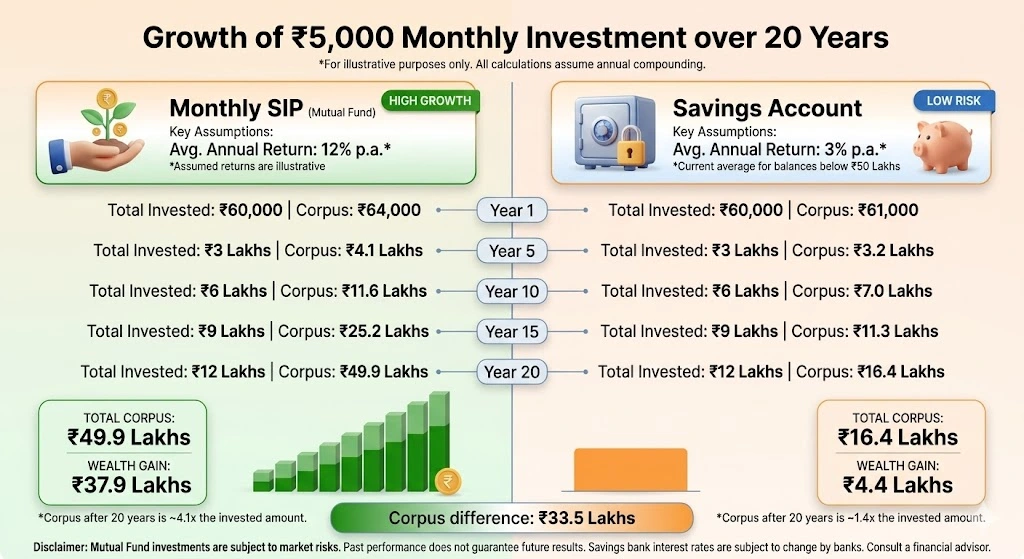
Saving protects you, but investing grows your wealth. Inflation reduces the value of your money every year. Keeping all your cash in a standard savings account actually makes you poorer over time.
Beginner friendly options in 2026 include:
- Mutual Funds (SIP): A Systematic Investment Plan allows you to invest small amounts regularly in diversified funds.
- Index Funds: These track the Nifty 50 or Sensex. They have low fees and are perfect for long term growth.
- Public Provident Fund (PPF): A government backed option offering stability and tax benefits under the old regime.
- Bonds: In 2026, corporate bonds and Government Securities (G-Secs) offer attractive yields that often beat traditional Fixed Deposits.
Step 6: Protect your wealth with insurance
Insurance is not an investment tool. It is financial protection. Without it, a single hospital bill could swallow three years of your hard earned savings.
- Health Insurance: Essential to cover rising medical costs without touching your portfolio.
- Term Life Insurance: If you have dependents, this provides a massive payout for a very low annual premium. It is the purest form of protection for your family.
Read also: [How to Choose the Right Term Insurance Plan in India]
Step 7: Set clear, time-bound Goals
Planning is easier when you know the destination. Write down your goals and categorize them by time.
- Short-Term: Building the emergency fund or paying off a credit card.
- Medium-Term: Saving for a home down payment or a side business.
- Long-Term: Retirement planning and achieving total financial independence.
Common mistakes to avoid
Many beginners delay their growth by making avoidable mistakes. Living beyond your income is the biggest trap. If you cannot buy it twice in cash, you probably cannot afford it. Other mistakes include ignoring small recurring expenses and delaying your first investment because you are “waiting for the right time.” The best time was yesterday. The second best time is today.