
The Hidden Truth of how Banks profit from Credit Card Points

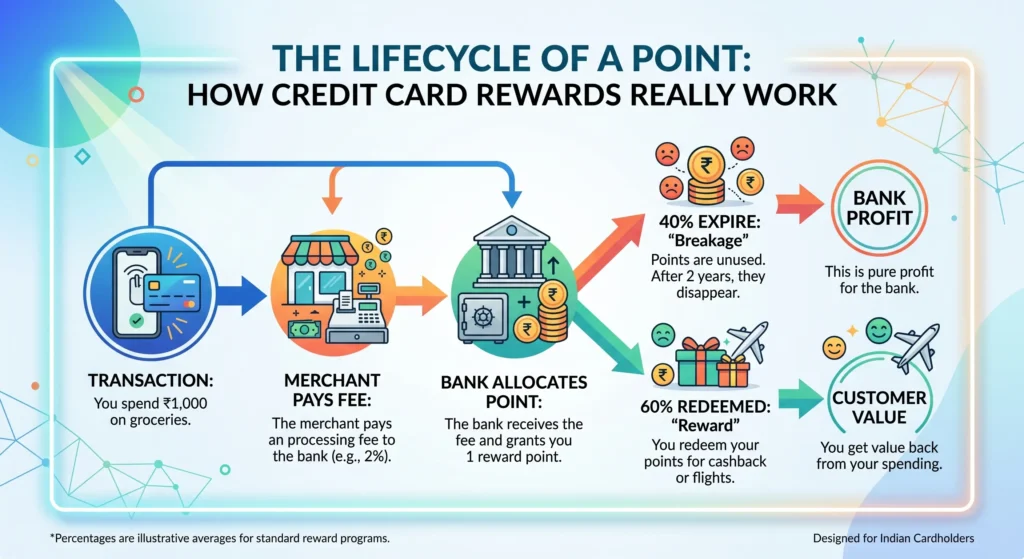
Banks in India generate revenue from reward programs through three primary channels: transaction-based interchange fees (0.7% to 2.2%), interest income from “revolving” balances (often hitting 46% APR in 2026), and “breakage,” where roughly 40% of points expire unredeemed. This ecosystem turns every swipe into a high-margin data and fee stream for the lender.
The Illusion of Free: Decoding the Reward Ecosystem
Let’s be honest, that “10x points” notification on your phone feels like a victory. In 2026, the Indian credit card market has exploded, with over 110 million active cards in circulation. Whether you are using a sleek metal card or scanning a RuPay QR code on UPI, the rewards seem like a gift. But here is the catch. Behind every “free” flight or cashback offer is a sophisticated multi-billion dollar revenue machine.
Banks don’t give away benefits out of generosity. They do it because the data and fees generated by your spending habits are worth far more than the 1% or 2% value you get back. It is a calculated engine designed to encourage higher spending and, eventually, profitable debt. To truly master your finances, you need to understand the gears moving behind the scenes.
1. The Revenue Engine: How Banks Profit from Every Swipe
How banks profit from credit card points starts at the very moment you tap your card or scan a merchant QR code. Every transaction triggers a complex chain of fees that ensures the bank wins before you even leave the store.
Interchange Fees and MDR Explained
The primary profit source is the Merchant Discount Rate (MDR). In the 2026 landscape, this fee typically ranges from 0.7% to 2.2% of your transaction value. This fee is split among the card network, the payment processor, and the bank that issued your card.
The specific portion that goes to your bank is known as the interchange fees explained. If you buy a ₹50,000 smartphone, the merchant might pay up to ₹1,100 just to process that payment. The bank uses a small slice of this to fund your “free” points and pockets the rest as margin. Interestingly, premium cards like the HDFC Infinia or Axis Magnus carry higher interchange fees. This means the merchant—and other customers through slightly higher prices is essentially subsidizing your luxury airport lounge access.
The UPI Evolution
With the 2026 dominance of RuPay-UPI credit cards, banks have unlocked a high-frequency revenue stream. While small-ticket UPI transactions often have lower MDRs, the sheer volume of “micro-spending” provides banks with a consistent flow of interchange revenue that was previously cash-only. Every ₹50 chai paid via a credit-linked UPI app adds a tiny drop to the bank’s massive profit bucket.
2. The Psychology of “Breakage” and “Slippage”
The most profitable reward point for a bank is the one you never use. In the industry, this is known as breakage and slippage. It is a core pillar of how banks profit from credit card points and underpins the entire issuer business model.
Why Banks Love Unused Points
As of 2026, data from the Reserve Bank of India (RBI) suggests that nearly 40% of reward points in India are never redeemed. For banks, these points represent a “non-interest-bearing liability.” When they expire, that liability is wiped off the books, turning into pure, 100% margin profit.
Banks use “countdown clocks” and complex expiration rules to ensure a high percentage of unredeemed reward points profit. If you don’t check the fine print, your hard-earned benefits vanish straight into the bank’s bottom line.
The “Slippage” Strategy
Banks also profit when you redeem points poorly. Imagine you have ₹5,000 worth of points. The bank “nudges” you toward a branded toaster in their catalog where the points are only worth ₹0.25 each. If you had used them for a flight, they might have been worth ₹1.00 each. By steering you toward these low-value redemptions, the bank effectively saves 75% of the reward’s cost. It is a psychological game where the bank bets on your convenience over your math skills.
Read more: Personal Finance for Beginners: A Complete 2026 Guide
3. Interest Rates: The High-Profile Cash Cow
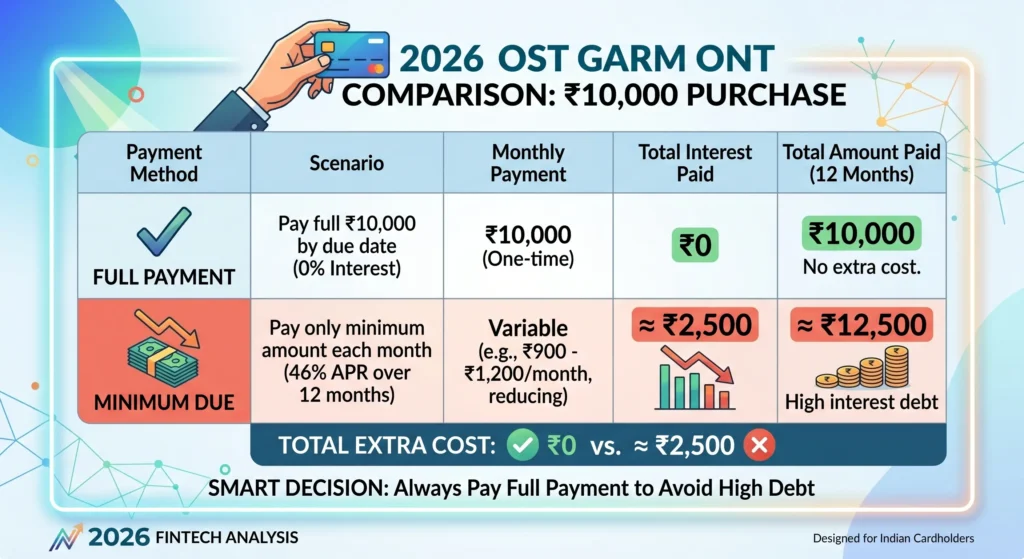
Despite the growth in fee-based income, interest remains the primary driver of revenue. In 2026, average annualized interest rates (APR) in India range from 36% to a staggering 46%. This is the reality of how banks profit from credit card points when consumers fail to pay in full.
The “Minimum Due” Trap
Banks are legally required to show you the “Minimum Amount Due” on your statement. This makes a ₹1 lakh hospital bill that empties your savings feel like a manageable ₹5,000 monthly expense. However, paying only the minimum triggers interest on the entire balance, not just what is left over.
The 2026 pivot in regulations now requires banks to be more transparent about how long it will take to pay off a balance using only minimum payments. Yet, the high interest rates ensure that “revolving” customers those who carry a balance remain the most profitable segment for any bank.
4. Strategic Partnerships: The “Nudge” Economy
Banks no longer work in isolation. In 2026, co-branded partnerships like ICICI-Amazon, Axis-Flipkart, or Tata Neu HDFC are the gold standard for how banks profit from credit card points.
- Merchant Bounties: Stores pay banks to “nudge” you toward their platforms using bonus points.
- The Dopamine Loop: Earning “5x points” on a specific category triggers a dopamine release. This makes you 12-18% more likely to spend more than you originally intended.
- Data Goldmines: By partnering with retailers, banks get a 360-degree view of your life. They know what you eat, where you travel, and when you are likely to need a loan.
5. New 2026 Regulations: What You Must Know
The RBI’s Master Direction on Credit and Debit Cards, updated for 2026, has introduced some friction for banks but also new profit avenues. Understanding these rules is essential to grasping how banks profit from credit card points while staying compliant.
- 2FA for Everything: Now for each transaction that includes spends from UPI-linked credit card requires Two-Factor Authentication (2FA). While this reduces fraud, banks charge “convenience fees” for the technology infrastructure.
- Weekly Bureau Reporting: Starting April 2026, banks report users data to CIBIL every 7 days. This allows them to adjust your interest rates or “limit-enhancement” offers almost in real-time based on your behavior.
- Explicit Consent: From April 2026, Banks can not “auto-upgrade” users to a fee-heavy card without a recorded consent or digital signature.
6. The 2026 “User Commandments” (How to Win)
To ensure you aren’t just another data point in the bank’s profit report, you must follow the rules of the 2026 financial landscape.
- The 30% Utilization Rule: Using more than 30% of your total credit limit is a “silent score killer.” Keeping it low shows banks you aren’t “credit hungry.”
- The “Statement Date” Trick: Don’t just wait for the due date. Pay off large spends 2-3 days before the statement is generated so that a low balance is reported to credit bureaus like CIBIL.
- The UPI Filter: Use RuPay cards for merchant payments (P2M) only. P2P transfers often earn zero rewards and might even attract hidden fees.
- Audit Your Rewards Quarterly: In 2026, banks frequently “devalue” points. Check for updates on reward caps every three months to ensure your favorite card hasn’t become a “dead” card.
12 Quick Strategies to Outsmart the System
- Pay in Full: The only way to ensure points are actually free.
- The “Pre-Statement” Payment: Pay 90% of your bill 2 days before the statement date. This reports a low credit utilization to CIBIL, keeping your score high for better loan rates later.
- Match Cards to Spend: Use a fuel card for petrol and a shopping card for e-commerce.
- Watch Expiry Dates: Set a calendar reminder every 6 months to audit your points.
- Calculate the Point Value: If 1 point is worth less than ₹0.25, the card might not be worth the annual fee.
- Utilize No-Cost EMIs: Only if you have the cash ready. Use it to keep your money earning interest in a liquid fund.
- Scan Every Offer: In 2026, app-specific “Flash Rewards” often beat standard card points.
- Avoid Cash Advances: The fees (often 2.5%) negate any possible rewards.
- Check for Fee Waivers: Most cards in 2026 waive the fee if you hit a specific spend threshold.
- Leverage Milestone Rewards: Some cards give massive bonuses just for hitting a yearly goal.
- Know the APR: Always know your interest rate, even if you never intend to pay it.
- Avoid Wallet Loading: Now most of the banks charges atleast 1% fee for wallets loading (Mobikwik, Paytm etc) for above ₹2,000. Instead use direct UPI from your bank for small amounts instead.
- The Gold Multiplier: If you use premium cards, only redeem for high-value categories like flights or “Gold Catalogs.” Redeeming for cash-back is usually the worst value for your points.